































“99 Years since the British Occupation Operation of Penjwen”
The Treaty of Lausanne and Its Consequences
The Lausanne negotiations began in Lausanne, Switzerland, on November 20, 1922. The objective of the victorious powers of World War I, particularly Britain and France, was to restructure the political and geographical landscape of the Middle East. They sought to compensate the Kemalist Turkey—which had rejected the Treaty of Sèvres (August 10, 1920)—by accommodating its demands. The second round of talks began on April 23, 1923, and concluded on July 24, 1923, with the signing of a treaty consisting of 143 articles and two appendices. This treaty established a new political map that recognized the Kemalist Turkish state while dissolving the legitimate rights and future of the Kurds within its framework.
The Third Administration of Sheikh Mahmood Hafid
To divert Kurdish attention from the Lausanne proceedings and to finalize the annexation of the Mosul Vilayet into the newly formed Iraq, British forces evacuated Sulaymaniyah and its surroundings in mid-June 1923, withdrawing toward Baghdad. Sheikh Mahmood and his forces, then positioned in the mountainous border regions near the village of Piran and Penjwen, returned to Sulaymaniyah between June 18 and 26, 1923.
By early July 1923, the third cabinet of the Kurdistan Government was established under the title “The General National Assembly,” headed by Sheikh Mahmood. At the suggestion of the British, the Iraqi Council of Ministers issued several decrees on July 11, 1923, stating:
- The Iraqi government did not intend to appoint Arab officials in Kurdistan.
- The Iraqi government did not intend to prioritize the Arabic language over Kurdish in the region.
- All religious and civil rights of the local population were to be protected.
However, on July 21, 1923, the Administrative Inspector of Kirkuk (C.J. Edmonds) sent a letter on behalf of the High Commissioner warning Sheikh Mahmood not to interfere in areas outside his designated administration (such as Ranya, Qaladiza, Chamchamal, Halabja, Qaradagh, Sangaw, and Mawat), threatening severe consequences. Consequently, Sheikh Mahmood’s third administration was significantly more geographically restricted and besieged than his previous two.
The Conflict over the Mosul Vilayet
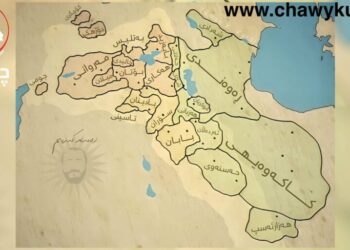
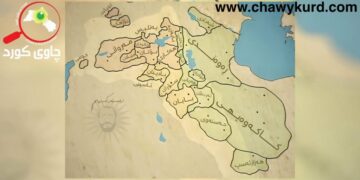
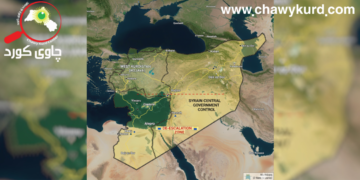
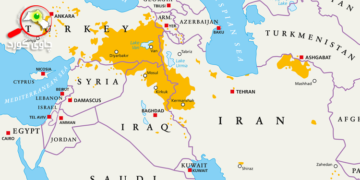
Following the Treaty of Lausanne, Article 3 (Paragraph 2) provided a nine-month period for Turkey, Britain, and Iraq to negotiate the border. The Mosul Vilayet consisted of:
- Central Sanjak (Mosul): Including Duhok, Zakho, Amadiya, Sinjar, and Akre.
- Kirkuk Sanjak: Including Erbil, Ranya, Rawanduz, Koya, and Kifri.
- Sulaymaniyah Sanjak: Including Bazyan, Halabja, Sharazur, and Marga.
Both Turkey and Iraq claimed the vilayet. When negotiations failed, the issue was referred to the League of Nations. In September 1924, a “Fact-Finding Commission” was formed, arriving in Baghdad in November 1924 to investigate the region’s political, geographical, and demographic composition.
Escalation of Conflict in Sulaymaniyah
British policy aimed to dissolve Kurdish institutions and integrate Sulaymaniyah as a province within Iraq. Tensions resurfaced, and Sheikh Mahmood’s forces launched attacks toward eastern Sulaymaniyah, Halabja, and Chamchamal to reclaim administrative control.
The British countered by sowing internal division, using money and weapons to turn local leaders against the Sheikh. Influential figures like Babakir Agha Pishder and Amin Agha of Chamchamal were swayed. With the support of the Kurdish “Levy” forces led by Salih Zaki Sahibqaran, several areas were seized from the Sheikh’s control.
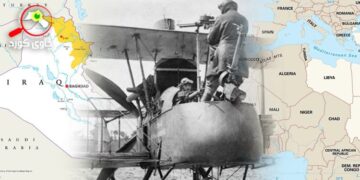
On May 23, 1924, following the killing of Assyrians in Kirkuk and citing the Sheikh’s interference in Mawat, the British Royal Air Force (RAF) dropped leaflets over Sulaymaniyah demanding the Sheikh’s surrender. Bombings began on May 25, 1924, destroying 50 to 100 homes and forcing the population to flee. By July 16, 1924, Sheikh Mahmood was forced to evacuate Sulaymaniyah, retreating to Sitak and eventually the border village of Piran near Mariwan (East Kurdistan/Iran).
Severing Financial Resources
By May 1926, the Iraqi Ministry of Interior issued Decree No. 1165, confiscating all properties and lands belonging to Sheikh Mahmood and his family. This was a devastating blow, as he lacked external state support to fund his forces.
In September 1926, after the Sheikh captured a British pilot whose plane had made an emergency landing, a window for negotiation opened. Sheikh Mahmood met with High Commissioner representative Kinahan Cornwallis in Khurmal, demanding:
- The return of his properties and control over Penjwen for his forces.
- An independent Kurdish government under a British mandate.
The British response was firm: the era of national privileges for Kurds in Iraq had ended. They warned that if the Sheikh caused trouble for the Iranian government, he would be declared an obstacle to peace, and any agreements would be voided.
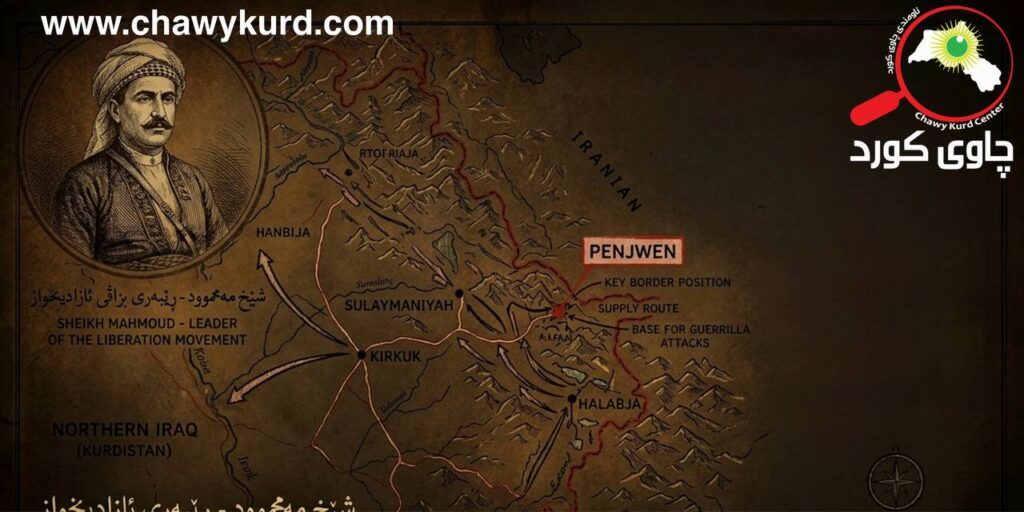
The Strategic Importance of Penjwen
Penjwen served as a vital sanctuary for Sheikh Mahmood due to:
- Geography: Its rugged mountains and dense forests provided ideal cover for guerrilla warfare.
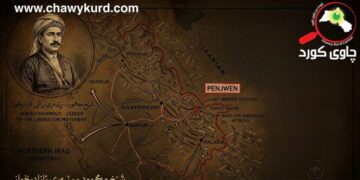
- Proximity to the Border: Located 105 km northeast of Sulaymaniyah, it allowed easy access to both Sulaymaniyah and the Iranian border towns of Baneh and Mariwan.
- Local Alliances: It enabled direct support from influential figures in East Kurdistan, such as Mahmood Khan Dizli and Mahmood Khan Kanisanan.
The Operation to Occupy Penjwen (1927)
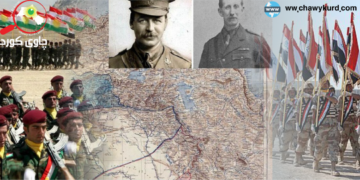
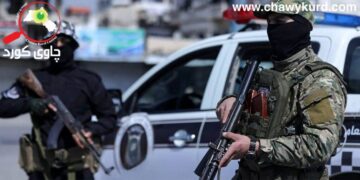
To finally suppress Sheikh Mahmood’s movement, the British and Iraqi forces launched the “Operation to Occupy Penjwen” from April 18 to May 7, 1927. Detailed RAF reports (written by Commander John Gilbert Browne) document the involvement of the Iraqi army, the RAF, and the Assyrian Levies.
- April 23: Forces entered Penjwen.
- April 25: Raza Beg, a former military leader under the Sheikh who had turned collaborator, was appointed as the new governor of Penjwen.
- May 7: After establishing permanent police and administrative control, the remaining troops returned to Sulaymaniyah.
On June 14, 1927, facing the loss of his strategic base and the betrayal of local allies, Sheikh Mahmood was forced to sign an 11-point agreement, effectively ending this phase of his armed struggle.
Conclusion: The imbalance of power consistently forced the Kurdish movement into weak negotiating positions, leading to settlements that failed to satisfy national aspirations.