






















































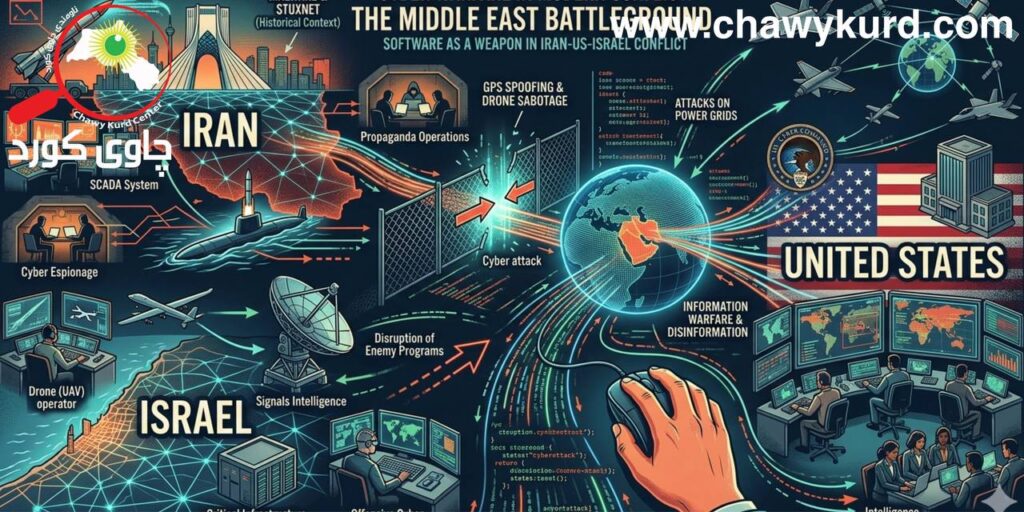
The recent escalation of tensions between Iran, the United States and Israel has revealed that modern warfare is no longer limited to missiles, drones and conventional military operations. In contrast, digital technology and cyber warfare—attacks carried out using computer software and systems—have become an vital part of modern conflict. In the 2026 confrontation, which began on February 28, 2026, cyber operations played a significant role alongside traditional military offensives. Cyber warfare—defined as the use of digital technology to attack or disrupt the information systems of another state—has become a key tool in geopolitical conflicts. In the confrontation involving Iran, the United States and Israel, cyber operations were used to destroy infrastructure, gather intelligence, and influence public perception and support military operations. In this article, what is further intended is how software, cyber-attacks and digital operations have affected conflict.
“The beginning of the conflict”
The final phase of the conflict began when the United States and Israel launched coordinated military attacks on Iranian targets. These attacks were aimed at weakening Iran’s military leadership, nuclear infrastructure and strategic capabilities. Following these attacks, Iran retaliated with missile attacks and military action targeting US and allied institutions in the Middle East. Conflict quickly expanded beyond conventional warfare to include digital and cyber operations conducted by governments and biased and dependent hacker groups.
“Cyber Warfare as a Strategic Tool”
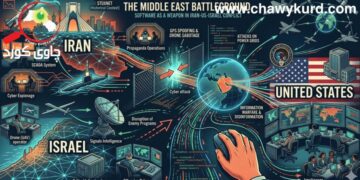
Cyber warfare has become a major component of conflict. Cyber operations were used to disrupt enemy communications, gather intelligence, and influence public perception. Coordinated U.S.-Israeli cyber operations disrupted Iran’s command, control and sensor networks before a physical airstrike occurred, helping to reduce Iran’s ability to respond effectively and in a timely manner early in the war, the researchers said. This cyber operation demonstrates how connected and software-based attacks can support traditional military strategies by weakening an adversary’s infrastructure before a physical attack is launched.
Modern cyber warfare focuses on targeting digital infrastructure, including telecommunications networks, power systems, military databases, and financial platforms. Cyber operations allow states to weaken their adversaries without launching traditional attacks. For example, the Stockinet cyber-attack—broadly attributed to U.S.-Israeli cooperation—targeted Iranian nuclear facilities in the early 2010s. The malware damaged centrifuges used in uranium enrichment at the Natanz nuclear facility, significantly slowing Iran’s nuclear program. The case is often cited as the first major electronic weapon used to create physical destruction in a strategic installation.
“Software Supporting Military Operations”
Electronic tools can aid military attacks by disabling defense systems and communication networks before attacks can occur.
Military analysts believe that cyber operations may be used to:
- Sabotage radar and missile detection systems
- Disable air defense networks
- Interfere with military communications
- Blocking satellite data transmission
“Information Warfare and Social Media Manipulation”
Another important aspect of cyber conflict is information warfare, which involves influencing public opinion through digital platforms.
Governments and electronic groups can;
- Spread propaganda on social media
- Hacking media websites
- Leakage of sensitive information
- Distribute disinformation campaign
“Attacks on crucial and sensitive infrastructure”
One of the most serious threats in cyber warfare is attacks on crucial infrastructure, including power grids, transportation systems, and financial institutions. A notable example is the Colonial Pipeline cyber-attack in 2021, when ransom ware hackers disrupted fuel supplies in the United States. Although the attack was carried out by a criminal group, not a state, it demonstrated how cyber operations can have a severe impact on national infrastructure.
In geopolitical conflicts, similar attacks could potentially:-
- Power grids.
- Oil and gas pipelines.
- Banking system.
- Transportation networks.
Such attacks can cause economic disruption without the firing of a single missile.
Finally
Experts note that cyber operations have become an integral part of modern warfare strategies and can significantly affect the outcome of conflicts. The confrontation between Iran, the United States and Israel illustrates how modern warfare has evolved into a hybrid model that combines conventional military operations with cyber warfare and digital intelligence. The recent confrontation between Iran, the United States and Israel demonstrates how electronic or cyber software and technology have become a major tool in modern warfare.