































“Kurdistan Region as an example”
“First; the concept and definition of fraud and electronic fraud”
The term forgery (or falsification) has been defined from various legal perspectives. According to a prominent legal opinion, in its simplest definition, this crime means: altering the truth in a written document with the intent to deceive, in a manner categorized as a crime by law, resulting in harm (which may be material, moral, or both).
In the Kurdistan Region, the amended Iraqi Penal Code No. 111 of 1969 is applied. It provides a precise definition for the crime of forgery in Article 286, stating: “Forgery is the alteration of truth with the intent of deception in a document, certificate, or any other writing, by one of the material or moral methods stipulated by law, such that this alteration results in harm to the public interest or to an individual.”
The development of computer technology—despite its vital features in developing programs and various services—has also provided opportunities for ill-intentioned individuals to use it for improper and illegal purposes, particularly for electronic crimes, due to the ease of manipulating and exchanging data and images. From this perspective, one expert believes it is “the use of computer systems and programs to commit crimes.”
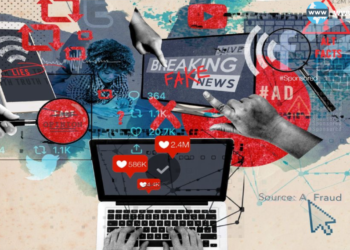
Social Media, a significant innovation of internet services, has created broad positive and negative impacts within global societies over the past decade due to the services it provides. Social media has granted participants various tools and opportunities for data exchange, rapid messaging, and sharing images, music, audio, and film. In other words, social media includes services such as exchanging letters, messages, and conversations in all media forms—auditory, visual, and written.
In reality, social media platforms are a collection of websites built on “Web 2.0 technologies,” capable of creating electronic communication within a “cyber environment.” The most prominent types include Facebook, Telegram, Instagram, Twitter (X), FriendFeed, Chat Rooms, etc., used for exchanging data and information among a massive number of users. According to another definition, social media consists of one or more electronic sites where users share their interests, hobbies, opinions, and activities, while also viewing the activities of others. In short, Social Networks are online services that allow users to have profiles, introduce themselves to others, and exchange information through an electronic system. Through these platforms, users can maintain existing relationships and create new social connections.
Despite these beneficial features for human society, the misuse of these platforms by various individuals, groups, and teams has led to the spread of the harmful phenomenon of forgery, which is considered a crime under international law. In this brief article, we highlight the types and methods of forgery on social media, the level of responsibility, and the types of punishment in the Kurdistan Region.
In light of these definitions, Electronic Forgery can be identified by the following signs:
- Altering the truth.
- Methodology: The execution is illegal and considered a crime.
- Result: The perpetrator acts for personal gain, causing material or moral harm to the opposing party or official state documents.
- Harm: The harm can be material, moral, or both.
- Direction of Harm: It targets public or private interests, and sometimes both.
Criminals resort to social media to commit electronic forgery due to several factors:
- Ease of manipulation: Facilitates the editing of data and images.
- Ease of transaction: Perpetrators widely advertise their crimes to attract the maximum number of “customers.”
- Anonymity of the perpetrator: Criminals often hide their identities to avoid accountability; accounts used for advertising forgery are often deleted once discovered.
- Evading legal punishment: Since social media is an international service, a forger may commit the crime from outside a country’s borders using intermediaries or electronic means, thereby escaping local legal penalties.
Second: Electronic Forgery within Social Media
Certain characteristics of social media have made it the most widespread communication network over the past decade:
- Facilitation of dialogue.
- Speed of information exchange with low costs. Sometimes users remain anonymous.
- The internet’s vast capacity for presenting information, such as accessing data, sending/receiving emails, and electronic shopping, which saves time.
While these traits serve human socialization, various groups and organized gangs have attempted to use social media for forgery. Below are the most prominent methods of committing and promoting forgery on social media in the Kurdistan Region:
- Deception and Fraud: Advertising fake products on social media. For example, a person or gang may advertise a famous brand or a service like “obtaining a foreign passport.” After receiving payment, the criminals disappear and close their accounts. Citizens should be cautious of electronic transactions with unknown parties who lack official licenses or physical locations.
- Example 1: Advertisements for foreign passports. After agreeing on a large sum, the money is sent to a bank account (often in countries with weak laws), and the criminals vanish.
- Example 2: Scammers call or message citizens claiming they have won a prize from a specific company. They ask for a “code” sent to the user’s phone. In reality, this code is to reset the user’s password and hijack their Facebook account to extort money.
- Electronic Forgery: Using programs to manipulate data, images, seals, and visas to sell them via social media. For example, altering the data or photo on an official document (degree, ID, passport) for a forged transaction.
This electronic crime is classified into several types:
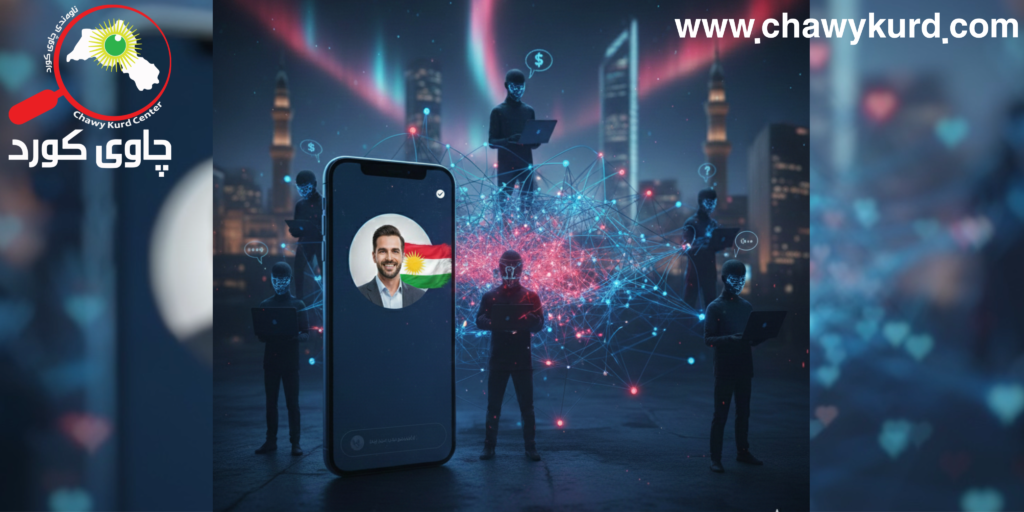
- Creating forged accounts and pages.
- Using advanced software to forge or manipulate voice, appearance, images, and videos.
To define this crime and its punishment, Article 292 of the Iraqi Penal Code No. 111 emphasizes that the penalty is imprisonment and/or a fine not exceeding 300 Dinars for anyone who uses a false name or identity to obtain an official license, an ID card, a general election ID, or a transit/travel permit.
The Iraqi Penal Code also classifies forgery into Moral and Material:
- Moral Forgery: Relates to words and statements. For example, using software to forge a person’s voice and associating it with an inappropriate event. It includes:
- Altering a person’s statement intended for a written record.
- Presenting a false event as real.
- Representing an unacknowledged event as acknowledged.
- Impersonating someone else or using false attributes to mislead the truth in a document.
- Material Forgery: Direct physical tampering, such as forging fingerprints, signatures, or physical documents.
Third: The Role of Media in Combating Electronic Forgery
The issue of misusing social media for crimes like electronic forgery remains a subject of great debate. Many countries and entities, like the European Union, have implemented specific laws and legal cooperation to combat these crimes. In the Kurdistan Region, media can play a vital role in controlling and eliminating electronic forgery through:
- Producing an Informed Society: Modern media can create “aware citizens” by exchanging information and exposing scams. Awareness must be a continuous process to keep up with evolving fraudulent methods.
- Cooperation with Legal and Executive Authorities: Social media can assist courts and security forces by exposing forgery cases, identifying perpetrators, and providing investigative reports or testimonies from victims.
Conclusion
The evolution of electronic forgery due to the widespread use of social media in the Kurdistan Region places a legal duty on every user. To build a healthy society, users must protect themselves from electronic crimes and report any forgery—whether through police, security forces, or the judiciary—to ensure criminals are caught and punished.