












The history of China’s acquaintance with the Middle East dates back to the middle ages. In the 20th century, however, the Israeli writer Yitzhak Shichor divided the Republic of China’s policy towards the Middle East into two stages: the Mao Zedong period and the post-Mao Zedong period. The post-Mao period is divided into two parts, the pre-1990s and the post-1990s. The post-Mao period until the 1990s can be classified as a period of transition, during which China was strong from within, and increasingly needed the outside world to continue its internal growth. After the 1990s, we can call it the oil era, when China became one of the major oil consumers in the region, and after the 2000s, a new phase of political, economic, security, geopolitical, technological and diplomatic relations. Therefore, the most important principles of the People’s Republic of China’s foreign policy in the Middle East can be summarized as follows:
China; wants to reach the West, just as when the West wanted to reach the East, they went through the Middle East, so China, which wants to reach the West, has to go through the Middle East.
China; Looking at the natural resources of the region, the Middle East currently meets about 60 percent of China’s energy needs. That is why the Middle East is the only region to reach the level of importance in China’s national security level.
The PRC wants countries in the region to become exporters of Chinese goods and invest in other areas such as infrastructure, housing and reconstruction. On the other hand, it is trying to establish relations with the Middle East not only in terms of goods, but also in terms of institutions, culture and consciousness.
China; needs the Middle East not only as a trading partner, but its position affects China’s internal security in terms of economic growth, energy resources and system legitimacy, because the main basis of Chinese system legitimacy comes from economic growth, not other areas.
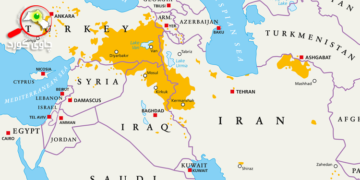
The Middle East is known for having several important waterways, which have a great impact on maritime transportation, especially the Suez Canal, the Strait of Bab al-Mandeb and the Strait of Hormuz.
On the other hand, it can be said that the implementation of the policy and power of the People’s Republic of China in the Middle East relies on three main tools and mechanisms: political and diplomatic mechanisms, economic and commercial mechanisms, media and cultural mechanisms.
First, the political and diplomatic mechanism: Despite China’s new diplomatic relations with the countries of the region, but the country has taken some major steps towards the activation of political and diplomatic relations in the Middle East in general and Arab countries in particular.
Second, economic and trade mechanisms: China is making great efforts to meet the needs of oil and natural gas in Arab countries, in light of the growth of energy demand, which increases by about 4% annually because of the multitude of joint activities between China and the countries of the Middle East region.
Third, the media and cultural mechanism: The cultural field is one of the most important areas of China’s expansion of its power in the Middle East. As part of its intensive efforts to disseminate the manifesto and worldview of the Communist Party of China, to this end, China has opened a number of language teaching centers and Confucius Institutes in the Middle East, such as:
Confucius Institutes: In 2006, the first Confucius Institute in the Arab world was established at St. Joseph’s University in Beirut. Since then, until the end of 2019, fourteen other institutes have been opened in the Middle East: one in Bahrain, Sudan and Tunisia. Two institutes in Jordan, the United Arab Emirates and Egypt, and three in Morocco. Other institutions were also established in the region, two in Israel, four in Turkey and the other in the Islamic Republic of Iran. In Iraq, Salahaddin University-Erbil has opened a Chinese language department in the College of Language since.
Media: China’s power in the Middle East is not only through Confucius Institutes and Chinese language teaching centers, but also through the media. For example, in July 2009, China’s central channel CCTV opened an Arabic language section in more than 22 Arab countries, it has 300 million viewers. According to Chinese officials, the channel’s goals are:
- Exchange of information between the Chinese and Arab peoples.
- Strengthening the spread of Chinese culture in the world.
- Correcting the Western Media’s Distorted View of China “Bristow 2009”.
In general, the power of the People’s Republic of China in the Middle East in general and Arab countries in particular is practiced through political and diplomatic mechanisms, economic and commercial tools, social and cultural media mechanisms, in order to achieve China’s hegemony and interests.